
Key Takeaways
- Remote monitoring systems can reduce security costs by 60-75% compared to traditional on-site security guards while providing 24/7 coverage
- On-site security guards excel in customer-facing environments and high-risk situations requiring immediate physical intervention
- Small businesses face a 424% increase in theft and security incidents since 2019, making proper security measures more critical than ever
- Modern remote monitoring utilizes AI and professional monitoring centers to detect threats in real-time, not just passive recording
- Many businesses find hybrid security approaches most effective, combining remote monitoring technology with strategic guard placement
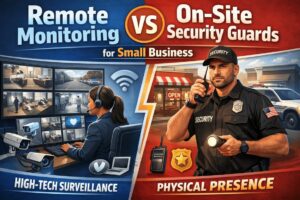
Why Your Small Business Security Choice Matters
The security decision you make today will impact your business’s protection, budget, and peace of mind for years to come. Small businesses face unique vulnerability—often targeted because criminals perceive them as having fewer resources for comprehensive security. Your choice between remote monitoring and on-site guards isn’t just about cost—it’s about finding the right balance of protection, deterrence, and response that fits your specific business needs. Nationwide Security Guards provides customized remote monitoring solutions that help business owners maximize security while controlling costs.
The landscape of small business security has transformed dramatically in recent years, with technology reshaping protection options while criminal tactics evolve simultaneously. Traditional guards and basic camera systems that merely record incidents for later review no longer provide adequate protection in many situations. Today’s business owners need proactive solutions that prevent incidents before they escalate into costly losses.
Rising Theft and Security Threats for Small Businesses
Small businesses have become increasingly targeted by both sophisticated and opportunistic criminals. According to recent security industry reports, retail theft alone has increased by 424% since 2019, with small businesses bearing the brunt of these losses. Organized retail crime rings specifically target businesses they perceive as having weaker security infrastructure. What’s particularly concerning is the growing boldness of these criminals—with 68% of theft now occurring during business hours when staff are present but often unable to intervene safely.
Property crimes against commercial establishments continue rising in most urban areas, with small businesses accounting for nearly 40% of all commercial break-ins despite representing a smaller percentage of commercial properties. These statistics highlight why proper security isn’t optional—it’s essential for business survival.
The True Cost of Security Breaches
The financial impact of security incidents extends far beyond the immediate loss of inventory or cash. When calculating the true cost of inadequate security, business owners must consider multiple factors that compound the damage. Insurance deductibles, increased premium costs following claims, and business interruption expenses can quickly eclipse the value of stolen merchandise. For those in the area, considering a security guard company in Boston might be a wise investment to mitigate these risks.
Employee safety concerns and potential workers’ compensation claims arising from security incidents add another layer of financial exposure. Perhaps most damaging is the long-term impact on customer confidence and business reputation. Studies show that up to 30% of customers may avoid businesses they perceive as unsafe, creating a lasting revenue impact that far exceeds the initial loss.
The Average Security Incident Costs Small Businesses:
• Direct theft/damage: $8,000-$12,000
• Insurance deductibles: $1,000-$5,000
• Business interruption: $5,000+ per day
• Long-term customer loss: Up to 30% of revenue
• Staff turnover/retraining: $3,500+ per employee. Learn more about professional security guard services to mitigate these risks.
Limited Protection With Traditional Options
Many small business owners rely on outdated security approaches that provide a false sense of protection. Basic alarm systems that simply make noise or traditional CCTV cameras that only record footage for later review offer limited preventative value. By the time an alarm triggers a response or footage is reviewed, criminals have usually completed their theft and departed.
Similarly, on-site guards—while providing visible deterrence—have inherent limitations in coverage area, attention span, and response capabilities. A single guard can only monitor one area at a time, creating predictable patrol patterns that sophisticated criminals can exploit. This reality necessitates examining more comprehensive and adaptive security approaches for today’s threats.
Remote Monitoring Systems: How They Work
Remote monitoring represents a fundamental shift in security strategy—from reactive to proactive protection. Unlike traditional surveillance that simply records incidents for later review, modern remote monitoring systems actively detect, deter, and respond to security threats in real-time. This approach combines advanced technology with human expertise to create a security solution that never sleeps, never takes breaks, and maintains consistent vigilance across your entire property.
24/7 Video Surveillance with Professional Monitoring
The core of effective remote monitoring starts with strategically placed cameras providing comprehensive coverage of your business property. These aren’t ordinary security cameras—they’re equipped with advanced capabilities like infrared night vision, wide dynamic range for difficult lighting conditions, and often AI-powered analytics. The video feeds connect to a professional monitoring center where trained security specialists oversee multiple locations simultaneously.
Unlike a single on-site guard limited to viewing one area at a time, monitoring center professionals can instantly switch between camera views, respond to automated alerts, and coordinate with authorities. This multiplies the effectiveness of each security professional while ensuring no area of your property goes unwatched. Most importantly, these systems provide true 24/7 coverage without the substantial cost increases associated with overnight or weekend guard shifts.
Real-Time Alert Systems and Response Protocols
Modern remote monitoring doesn’t rely on constant human observation alone. Advanced analytics and artificial intelligence significantly enhance system effectiveness by automatically identifying potential threats and triggering appropriate responses. These smart systems can distinguish between normal activity and suspicious behavior, such as loitering in restricted areas, attempts to defeat security measures, or movements during closed hours. For businesses looking to enhance their security, exploring professional security guard services can be a valuable consideration.
Real-Time Alert Systems and Response Protocols
Modern remote monitoring doesn’t rely on constant human observation alone. Advanced analytics and artificial intelligence significantly enhance system effectiveness by automatically identifying potential threats and triggering appropriate responses. These smart systems can distinguish between normal activity and suspicious behavior, such as loitering in restricted areas, attempts to defeat security measures, or movements during closed hours. For businesses looking to enhance their security measures, choosing the right mobile security patrols can be an effective complement to these technologies.
When a potential threat is detected, the system can immediately initiate a response sequence. This typically begins with automated deterrents like bright lights or audio warnings directly addressing the intruder. Simultaneously, alerts route to monitoring center professionals who can assess the situation via live video, communicate through two-way audio systems, and if necessary, dispatch local authorities with specific information about the threat. This layered approach creates multiple opportunities to prevent crime before significant damage occurs.
Equipment Needed for Effective Remote Monitoring
Creating an effective remote monitoring system requires careful component selection based on your specific business vulnerabilities and property layout. High-definition cameras with appropriate specifications for your environment form the foundation—including weatherproof models for exterior coverage and specialized options for challenging lighting conditions. These cameras connect to a secure network video recorder (NVR) or cloud storage solution that maintains footage for evidence and review.
Two-way audio systems enable direct communication with site visitors or potential intruders, serving both customer service and security functions. Motion sensors, glass-break detectors, and door contacts provide additional layers of protection by triggering alerts when physical security is compromised. The entire system requires reliable internet connectivity with appropriate bandwidth, often with cellular backup to maintain protection during network outages.
Installation Process and Setup Requirements
Professional installation ensures optimal placement and configuration of all security components. The process begins with a comprehensive site assessment to identify vulnerable areas, entry points, and high-value assets requiring priority protection. Installers strategically position cameras to eliminate blind spots while maximizing coverage of critical areas. The system undergoes thorough testing and calibration to reduce false alarms while maintaining sensitivity to genuine threats.
Once physical installation completes, security professionals configure alert parameters, notification protocols, and response sequences. This customization ensures your system addresses your specific security concerns while minimizing unnecessary disruptions. Most providers offer ongoing maintenance and system health monitoring to maintain protection integrity over time.
On-Site Security Guards: The Human Element
Traditional security guards continue to play a valuable role in comprehensive business protection strategies. Their physical presence provides a visible deterrent that technology alone cannot fully replicate. Understanding the strengths, limitations, and operational considerations of on-site security personnel helps determine where they fit best in your overall security approach.
Roles and Responsibilities of Security Personnel
Professional security guards perform diverse functions beyond simply watching for intruders. They actively control access to premises, verify visitor credentials, and manage entry protocols that prevent unauthorized access. During business hours, they serve as visible deterrents while providing customer assistance and wayfinding—adding value beyond pure security functions.
Guards conduct regular patrols to maintain awareness of changing conditions, identify maintenance issues before they become security vulnerabilities, and establish unpredictable movement patterns that make it difficult for potential criminals to exploit routine gaps. They can physically intervene during confrontations, detain suspects when appropriate, and provide immediate first responder assistance during medical emergencies or natural disasters.
Types of Guard Services Available
Security guard services come in various specializations and deployment models to meet different business needs. Uniformed guards provide high-visibility security with official appearance and equipment that emphasizes their authority and deters potential threats. Plain-clothes security specialists offer discrete protection in retail environments, focusing on loss prevention while maintaining a customer-friendly atmosphere.
Armed guards receive additional training and certification to carry weapons, appropriate for high-risk environments or businesses handling valuable assets. Mobile patrol services cover multiple locations with periodic visits rather than continuous presence, offering a more affordable option for basic security checks. Each type comes with different training requirements, liability considerations, and cost structures that influence their suitability for specific security needs. For a deeper understanding, consider debunking myths about armed security guards.
Hiring Process and Background Verification
Reputable security firms implement rigorous screening procedures before deploying guards to client locations. This process typically includes comprehensive background checks investigating criminal history, employment verification, and reference validation. Drug screening and psychological assessments help identify candidates with appropriate temperament for security work, where judgment and self-control are essential traits.
Licensing requirements vary by location but generally include state-mandated training and certification verification. These procedures protect businesses from liability associated with inadequately screened personnel while ensuring guards have the basic qualifications needed for effective service. However, the quality of these processes varies significantly between security providers, making provider selection a critical decision point.
Training Requirements for Effective Security
Effective security personnel require specialized training beyond basic certification. This includes situation assessment skills that help distinguish genuine threats from normal activities, de-escalation techniques for managing confrontations without excessive force, and emergency response protocols for various scenarios. Communication training ensures guards interact professionally with customers, employees, and potential threats.
Site-specific training familiarizes guards with your particular business operations, vulnerable areas, and special protection requirements. Many organizations supplement basic guard training with additional instruction about their specific industry risks, customer service standards, and operational procedures. This specialized knowledge significantly enhances guard effectiveness but adds to onboarding time and training costs.
Cost Comparison: What You Really Pay
Making an informed security decision requires understanding the complete financial picture beyond headline hourly rates or equipment costs. Both remote monitoring and on-site guards involve various expenses that affect their total cost of ownership and return on security investment.
Location-Specific Security Deployment
Different areas of your business property may require varying levels of security based on risk factors and operational needs. Front entrances and customer-facing areas often benefit from the welcoming presence of security personnel who can assist visitors while monitoring for suspicious behavior. Meanwhile, storage areas, loading docks, and perimeter boundaries typically require consistent surveillance but less frequent physical presence, making them ideal for remote monitoring solutions.
Cost-Effective Hybrid Models
Many businesses find that allocating their security budget strategically across both technologies yields optimal protection. For example, employing a single security officer during peak business hours while relying on remote monitoring during nights and weekends can reduce costs by up to 65% compared to 24/7 guard coverage. This approach maintains the deterrent effect of visible security during high-traffic periods while ensuring continuous protection during vulnerable off-hours.
Industry data shows that businesses implementing strategically designed hybrid security approaches experience 32% fewer security incidents than those relying exclusively on either guards or technology alone. The key lies in thoughtful integration—ensuring both components work together rather than functioning as separate systems. When remote monitoring teams can communicate directly with on-site personnel, response times decrease and coordination improves significantly.
Insurance Benefits and Liability Considerations
Your security choices significantly impact both insurance costs and potential liability exposure. Most commercial insurance providers offer premium discounts for businesses that implement comprehensive security measures, recognizing that proactive protection reduces claim frequency and severity. However, these benefits vary considerably depending on the specific security approaches you deploy and how well you document their implementation.
Beyond direct cost savings, proper security measures provide crucial protection against potential negligent security lawsuits. Businesses have a legal duty of care to implement reasonable security measures based on foreseeable risks. Failing to meet this standard can result in significant liability if criminal incidents occur that proper security could have prevented.
Premium Reductions for Security Investments
Insurance carriers typically offer tiered premium discounts based on the sophistication and comprehensiveness of your security program. Basic measures like alarm systems and standard locks might qualify for minimal reductions of 2-5%, while integrated security systems with professional monitoring often secure discounts between 5-15%. The most substantial savings come from comprehensive programs combining physical security, electronic monitoring, and documented security protocols, which can reduce premiums by 10-20% or more depending on your industry and location.
Documentation Requirements for Claims
When security incidents occur, your ability to recover losses through insurance claims often depends on proper documentation. Remote monitoring systems provide distinct advantages in this area by automatically maintaining detailed video evidence, access records, and chronological logs of all security events. This documentation can prove invaluable during claim investigations, potentially expediting claim processing and improving settlement outcomes. For businesses considering additional security measures, such as hiring security guards, it’s essential to understand how these services can complement your existing security infrastructure.
Insurance carriers increasingly require evidence that security systems were functioning properly and that business owners maintained reasonable security protocols. Remote monitoring services typically generate automated system health reports and activity logs that satisfy these documentation requirements more consistently than manual security logs maintained by guards.
Liability Differences Between Options
On-site security guards create distinct liability considerations that remote monitoring largely avoids. When employing security personnel—whether directly or through contractors—businesses assume responsibility for their actions during security incidents. Excessive force allegations, discrimination claims, or failure to intervene appropriately can create significant liability exposure beyond the initial security incident itself. Remote monitoring shifts much of this liability to service providers while still maintaining response capabilities through local law enforcement when necessary.
Making the Right Choice for Your Business
Selecting the optimal security approach requires evaluating your specific business vulnerabilities, operational patterns, and protection priorities. Start by identifying your most valuable assets—whether inventory, intellectual property, equipment, or cash—and assessing their relative risk exposure. Consider your operating hours, typical occupancy patterns, and surrounding neighborhood conditions that might influence security threats.
Budget constraints naturally influence security decisions, but focusing exclusively on initial costs often leads to inadequate protection. Instead, evaluate the total cost of ownership across a 3-5 year horizon, including equipment, personnel, maintenance, training, and potential incident costs. This broader perspective frequently reveals that higher initial investments in quality systems deliver better long-term value.
Finally, consider how security measures affect your overall business operations and customer experience. The best security solutions integrate seamlessly with your business model rather than creating friction or inconvenience for legitimate operations. Remote monitoring often excels in this area by providing comprehensive protection with minimal operational impact.
|
Security Need |
Remote Monitoring Effectiveness |
On-Site Guard Effectiveness |
Recommended Approach |
|---|---|---|---|
|
After-Hours Protection |
Excellent |
Good but Costly |
Remote Monitoring |
|
Customer-Facing Security |
Moderate |
Excellent |
On-Site Guard |
|
Multiple Location Coverage |
Excellent |
Poor |
Remote Monitoring |
|
Emergency Response |
Good |
Excellent |
Hybrid Approach |
|
Budget Efficiency |
Excellent |
Poor to Moderate |
Remote Monitoring |
Risk Assessment Process
A structured risk assessment provides the foundation for effective security planning. Begin by cataloging all assets requiring protection and their relative value to your business. Map your physical space to identify points of vulnerability such as isolated areas, multiple access points, or locations containing high-value assets. Review any previous security incidents at your location or similar businesses in your area to identify pattern-based threats.
Consider operational factors that influence security requirements, including hours of operation, staffing patterns, cash handling procedures, and customer demographics. Evaluate neighborhood conditions, nearby businesses, and local crime statistics to understand environmental risk factors. This comprehensive assessment creates a prioritized understanding of security needs that guides technology selection and deployment strategies.
Budget Planning for Security Investments
Developing a realistic security budget requires balancing immediate protection needs with long-term financial sustainability. Most security consultants recommend allocating 1-3% of annual revenue toward protection measures, though this varies considerably based on industry, location, and specific risk factors. When evaluating remote monitoring options, consider both initial equipment investments and ongoing monitoring fees, which typically range from $100-500 monthly depending on system complexity and monitoring intensity.
Implementation Timeline Considerations
Transitioning between security approaches requires careful planning to avoid temporary vulnerabilities. Remote monitoring systems typically require 2-4 weeks for complete implementation, including site assessment, equipment installation, system testing, and staff training. Security guard services can often deploy more quickly—sometimes within days—but require more extensive onboarding to familiarize personnel with your specific business operations and security priorities.
Future-Proofing Your Security Investment
The security landscape continues evolving rapidly, with both threat methodologies and protection technologies advancing constantly. Making forward-looking security decisions helps ensure your investments remain effective as your business grows and security challenges evolve. Remote monitoring systems generally offer superior adaptability through software updates and modular expansion compared to personnel-based approaches that require extensive retraining or additional hiring.
Cloud-based security platforms provide particular advantages for future adaptability, allowing new capabilities to deploy through software updates rather than equipment replacement. These systems also facilitate integration with other business technologies like access control, employee management, and operational analytics, creating additional value beyond pure security functions.
Regularly reviewing and updating your security approach based on changing business needs, emerging technologies, and evolving threats ensures continued protection effectiveness. The most successful security programs build in periodic reassessment processes rather than treating security as a one-time implementation decision.
Technology Trends in Remote Monitoring
Artificial intelligence capabilities continue transforming remote monitoring effectiveness through increasingly sophisticated threat detection algorithms. Modern AI systems can distinguish between ordinary activity and suspicious behavior with remarkable accuracy, dramatically reducing false alarms while improving threat identification. These systems learn from experience, becoming more effective over time as they analyze patterns specific to your business environment.
Integration between security systems and business operations technology represents another significant trend. Modern remote monitoring platforms can connect with point-of-sale systems, inventory management, and customer analytics to provide insights beyond security alone. For example, the same cameras monitoring for theft can analyze customer traffic patterns, measure display effectiveness, or verify proper operational procedures.
Changing Landscape of Security Services
The traditional boundaries between technology providers and security personnel firms continue blurring as comprehensive security solutions emerge. Many leading providers now offer integrated approaches combining remote monitoring technology with rapid-response mobile guards who deploy only when necessary. This hybrid model delivers the consistent coverage of technology with the intervention capabilities of personnel while optimizing cost-effectiveness.
Scalability as Your Business Grows
Remote monitoring systems offer distinct advantages for growing businesses by scaling more efficiently than personnel-based security. Adding coverage for new locations, expanding monitored areas within existing facilities, or increasing protection intensity during growth phases can occur without proportional cost increases. This scalability makes remote monitoring particularly valuable for businesses anticipating significant growth or operating seasonal variations in security needs.
Frequently Asked Questions
Business owners consistently raise important questions when evaluating security options. The answers below address the most common concerns about both remote monitoring and on-site security guards based on real-world implementation experience across various industries.
Can remote monitoring completely replace security guards?
For many businesses, remote monitoring can effectively replace traditional guards while providing superior coverage at lower cost. However, environments requiring frequent physical intervention, customer service interaction, or immediate emergency response may still benefit from some on-site presence. The most effective approach often combines remote monitoring for comprehensive surveillance with targeted guard deployment during high-risk periods or in critical areas. For national businesses, finding a reliable security guard company can be crucial to implementing this combined approach effectively.
What happens during a power outage with remote monitoring systems?
Quality remote monitoring systems include multiple redundancies to maintain protection during utility disruptions. Battery backup systems typically provide 4-8 hours of continued operation for essential components, while cellular communication backups maintain monitoring center connectivity if internet service fails. Some advanced systems even include small generators that activate automatically during extended outages.
These backup systems continue monitoring critical areas while simultaneously alerting both business owners and monitoring professionals about the power disruption. This dual function ensures continued protection while facilitating rapid response to potential infrastructure failures.
How long does it typically take to install a remote monitoring system?
Implementation timelines vary based on property size, system complexity, and specific security requirements. For typical small business applications, the process takes 2-4 weeks from initial consultation to fully operational status. This includes site assessment (2-3 days), system design (3-5 days), equipment procurement (5-10 days), physical installation (1-3 days), and system configuration/testing (2-3 days).
Are security guard services typically contracted or employed directly?
Most small businesses utilize contracted security services rather than direct employment due to significant administrative advantages. Contract security firms handle officer licensing, certification, training, scheduling, liability insurance, and replacement personnel during absences. This arrangement reduces management overhead while providing access to a larger security workforce than direct employment typically allows.
However, contracted services require careful provider selection based on reputation, officer training standards, supervision practices, and client retention rates. The quality difference between security firms varies dramatically, making due diligence essential before committing to a provider relationship.
What security measures work best for retail small businesses?
Retail environments benefit from layered security approaches addressing their unique vulnerability to both shoplifting and after-hours break-ins. During business hours, strategically placed visible cameras with remote monitoring capabilities deter opportunistic theft while providing evidence when incidents occur. These systems work effectively alongside inventory control measures like RFID tags and strategic merchandise positioning.
After hours, comprehensive alarm systems with motion detection, glass-break sensors, and remote video verification prevent false alarms while ensuring rapid response to actual intrusions. Many retailers find that investing in quality lighting, both interior and exterior, significantly enhances security effectiveness by eliminating concealment opportunities and improving video quality.
Nationwide Security Guard provides customized retail security solutions that balance protection needs with budget considerations, helping store owners reduce shrinkage while creating safe shopping environments for customers and staff alike. Contact our security specialists today for a comprehensive assessment of your retail location’s specific protection requirements.